How to Choose the Right Packing Tape Width and Type for Heavy Packages: 2in vs 3in Compared
Introduction
One will discover how to evaluate package dimensions, weight, and handling conditions before selecting a tape width. The guide explains why a 2‑inch tape may be sufficient for certain shipments while a 3‑inch tape provides additional surface area for heavy loads. Readers will also learn how to match tape type—clear acrylic versus industrial‑strength solvent‑free adhesive—to specific environments. By the end of this article, one will be able to make an informed purchase decision and apply the tape efficiently.
What You'll Need
- Scotch Heavy Duty Packing Tape – 6 rolls, 1.88 in × 22.2 yd, $11.98, 4.8/5 rating
- Duck Heavy Duty Clear Packing Tape – 6 rolls, 2 in × 54.6 yd, $15.18, 4.7/5 rating
- Scotch Heavy Duty Shipping Tape – 6 rolls, 1.88 in × 54.6 yd, $19.98, 4.7/5 rating
- Mr. Pen Packing Tape – 2 rolls, 2 in × 60 yd, $6.99, 4.5/5 rating
- Clear Heavy Duty Packing Tape – 6 rolls, 2 in × 68 yd, $11.69, 4.5/5 rating
Step 1: Assess Package Requirements
One should begin by measuring the length, width, and height of each box that will be shipped. Next, calculate the total weight and identify any fragile or high‑value contents that may experience rough handling. It is important to note the type of cardboard—recycled, corrugated, or double‑wall—as some adhesives perform better on specific surfaces. Finally, record the number of seams that will require sealing, because each seam will consume a predictable length of tape.
When the package weight exceeds twenty pounds, a wider tape such as a 2‑inch or 3‑inch option provides a larger bonding area, reducing the risk of seam failure. For boxes constructed from 100% recycled material, an industrial‑strength adhesive is advisable to overcome the lower surface energy. The assessment stage determines whether a clear acrylic tape (e.g., Duck HD Clear) or a solvent‑free polymer tape (e.g., Scotch Heavy Duty) is more appropriate.
Step 2: Choose the Appropriate Tape Width
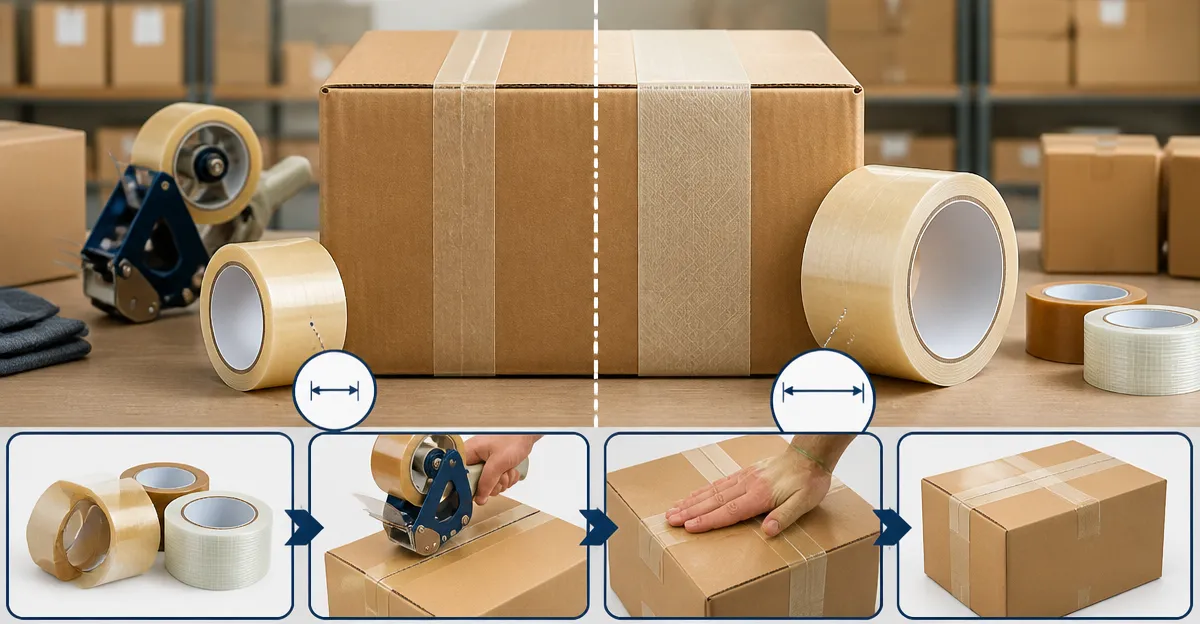
If the box has a standard 12‑inch width, a 2‑inch tape will cover approximately 16% of the side surface per strip, which is often sufficient for medium loads. For heavy packages, a 3‑inch tape—such as the Scotch Heavy Duty Packing Tape—covers roughly 25% of the side surface, providing greater shear resistance. One should also consider the number of seams; a single 3‑inch strip can replace two 2‑inch strips on a high‑stress edge.
When budget constraints exist, the Mr. Pen Packing Tape offers a cost‑effective 2‑inch option at $6.99 for two rolls, making it suitable for occasional use. For professional movers or small businesses that require consistent performance, the Duck Heavy Duty Clear Packing Tape delivers a 2‑inch width with a long‑lasting acrylic adhesive at $15.18 for six rolls. The price per yard is higher, but the clear finish maintains a professional appearance on customer‑facing packages.
Step 3: Select the Tape Type Based on Environment
Clear acrylic tapes excel in temperature‑fluctuating environments because the adhesive remains flexible in both hot and cold conditions. The Duck HD Clear Packing Tape explicitly states wide temperature performance, making it ideal for outdoor storage or warehouse climates. Conversely, solvent‑free industrial adhesives, as found in Scotch Heavy Duty Shipping Tape, provide instant adhesion and superior resistance to slivering, splitting, and tearing, which is essential for rough‑handling shipments.
One should also evaluate regulatory compliance; both Scotch and Duck tapes meet postal regulations for shipping, but the Scotch brand includes a guarantee that the tape will stay sealed, with a refund policy if it does not. For users who need a tape that does not emit strong odors, the Mr. Pen Packing Tape is marketed as “No Smell,” which can be advantageous in office settings or when packaging food‑related items.
Step 4: Apply the Tape Correctly
Begin by positioning the roll on a flat surface and ensuring the dispenser or tape gun is loaded according to the manufacturer’s instructions. For rolls that include a built‑in dispenser—such as Scotch Heavy Duty Packing Tape and Scotch Heavy Duty Shipping Tape—use the fall‑back tabs to prevent the tape from slipping back onto the roll. Pull the tape taut, align it with the seam, and press firmly for at least three seconds to activate the adhesive.
When sealing heavy boxes, apply the tape in a “H‑pattern” or “X‑pattern” to distribute stress evenly across the joint. Use a second strip perpendicular to the first to create a cross‑reinforcement. For clear acrylic tapes, a gentle heat source (such as a hair dryer) can improve adhesion on cold surfaces, as noted in the Duck product reviews. Finally, inspect each seam for gaps; any visible space should be covered with an additional strip to guarantee a hermetic seal.
Tips & Pro Tips
- Store tape rolls in a climate‑controlled area to maintain adhesive integrity.
- For boxes with irregular edges, cut the tape with scissors rather than relying on the dispenser, especially when using the Clear Heavy Duty Packing Tape which fits standard dispensers.
- When using clear tapes on address labels, ensure the tape does not obscure barcodes; the crystal‑clear nature of Duck HD Clear and Mr. Pen tapes allows scanners to read through the material.
- Apply a light pressure with a roller or the flat side of a credit card to eliminate air bubbles and improve bond strength.
- Reserve one roll of each brand as a backup; this practice prevents workflow interruptions during high‑volume shipping periods.
Troubleshooting
Problem: Tape does not adhere to recycled cardboard.
Solution: Switch to a solvent‑free industrial adhesive such as Scotch Heavy Duty Shipping Tape, which is specifically formulated for harder‑to‑stick surfaces.
Problem: Tape splits or tears during application.
Solution: Use a dispenser with fall‑back tabs (included with Scotch rolls) to maintain tension, and avoid pulling the tape too quickly.
Problem: Clear tape leaves a residue on painted surfaces.
Solution: Apply the tape only to dry, non‑porous surfaces; if removal is necessary, use a paint‑compatible adhesive remover or a razor blade scraper as suggested in the Duck product reviews.
Conclusion
One now possesses a systematic approach to selecting between 2‑inch and 3‑inch heavy‑duty packing tapes, understanding the impact of adhesive chemistry, and applying the tape in a manner that maximizes security. By assessing package requirements, choosing the appropriate width, matching the tape type to the environment, and following proper application techniques, one can reduce package damage and improve customer satisfaction. The recommended products provide reliable options for both occasional and high‑volume shippers, ensuring that every box remains sealed throughout its journey.
Products Mentioned in This Guide
Frequently Asked Questions
When should I choose 2‑inch packing tape over 3‑inch tape for heavy shipments?
Use 2‑inch tape for lighter or smaller parcels (generally under 20 lb) where the box edges aren’t under extreme stress; opt for 3‑inch tape when the package is heavier, larger, or requires extra surface area for added strength.
What are the key factors to evaluate before selecting a tape width?
Consider the package dimensions, weight, handling conditions, and the amount of surface area needed to securely seal the box.
How does clear acrylic tape differ from industrial‑strength solvent‑free adhesive tape?
Clear acrylic tape offers good clarity and moderate hold, while industrial‑strength solvent‑free adhesive provides a stronger, temperature‑resistant bond ideal for harsh environments.
Is a wider tape always better for heavy packages?
A wider tape (3 in) provides more bonding area, which improves load distribution, but it isn’t necessary if the package is within the weight limits of a high‑quality 2‑in tape.
Can I use the same tape type for both indoor and outdoor shipping?
For outdoor or extreme temperature shipping, choose industrial‑strength solvent‑free adhesive tape; for indoor shipments, clear acrylic tape is usually sufficient.